SlowTeching V0.1: A Reflective Framework for Intentional Technology

I’d just arrived at the train station when I realised my Thameslink app wasn’t working, and my ticket wouldn’t load. Annoying, I know. As I walked towards the station entrance, I noticed a small, disgruntled-looking crowd of people, huffing as they stared down at their phones.
A voice came over the tannoy…
“We would like to announce a widespread outage of the Thameslink app. Please make your way through the barriers.”
The barriers were opened, and we were funnelled onto our trains.
This was just one small and mundane example of how much of our lives hinge on technology, in this case, apps.
I was a little frustrated (there always seems to be an issue with the trains these days), and so when I took my seat on the Bedford-to-Brighton line, I decided to let off some steam by texting my mum. I’ll share her reply with you below because it’s rather amusing and illustrates some of the points I’ll make in this blog post.
I’ll let you read it now:
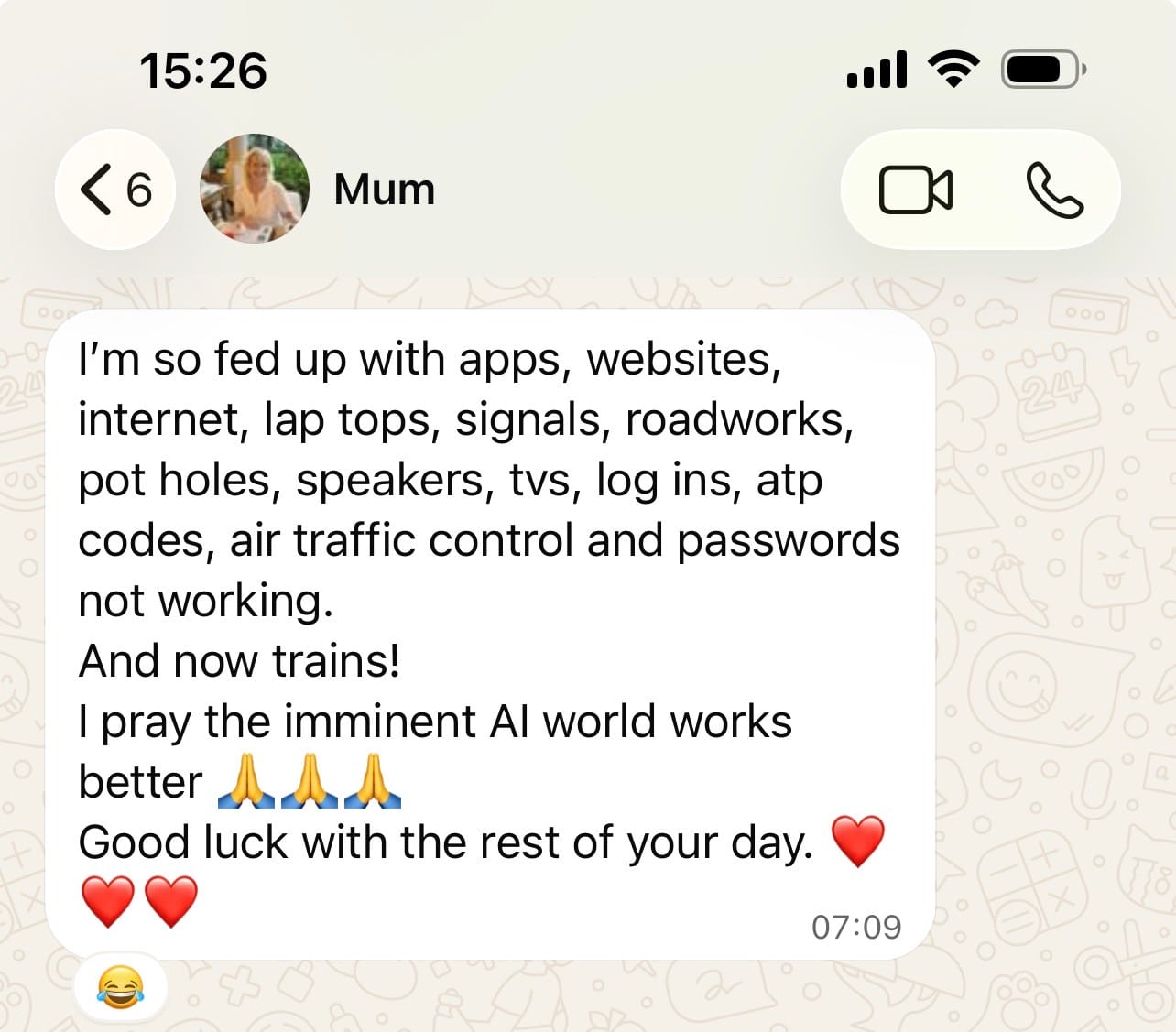
We’ve all experienced the same frustration as my mum here, but what interested me most is where she says, “I pray the imminent AI world works better”, because I’m not 100% sure whether it will, or whether we’ll end up with another technology that we rely on, that sometimes breaks.
So this all leads me to a question, and I’ve been exploring this question in some form over the past year.
What is technology doing to us, while it does things for us?
What you’re about to read is my attempt to explore this (rather large) question. It’s an independent project that I’ve been working on in my own time (hello, evenings and weekends).
This is my current definition of this project:
SlowTeching is an emerging reflective practice that gives people the opportunity to pause, reflect, and exercise agency over how they use existing and emerging technologies, rather than defaulting. The framework aims to empower people to use technology intentionally and deliberately, and for the ultimate purpose of enhancing their flourishing.
Where did it all begin?
I began the year by noticing a tension. That tension lies between dominant big-tech narratives and what we tend to think of as learning. In dominant tech narratives, the focus tends to be on efficiency: growth at all costs, doing more, doing it faster. This narrative runs counter to what we tend to think of as learning.
When we learn, we still think of growth, but growth of the individual. We think of the messy, uncomfortable, long and winding road between not knowing something and knowing it. When we learn, we have to take small, consistent steps; we pause, and we go backwards if something isn’t working.

This led me to ask another question: what are we actually designing for in Higher Education (and in education in general)?
I don’t think we’re designing for efficiency. It must be something else.
For Flourishing’s Sake
This is where I discovered flourishing. I’d heard the term used a few times, so I decided to do some digging. My research led me down quite the rabbit hole, and one that I think I could happily spend my life exploring.
To give you some background, flourishing is not a new term; it’s an ancient term that dates back to Aristotelian philosophies that ask what it means to live a good, full human life.
After exploring three flourishing and well-being frameworks, I began to focus on six core areas that are interesting when viewed through a technological lens. You can see these areas below.
The frameworks that informed this thinking include the Harvard Human Flourishing Program, the OECD Wellbeing Framework, and the PERMA model, which stems from positive psychology.
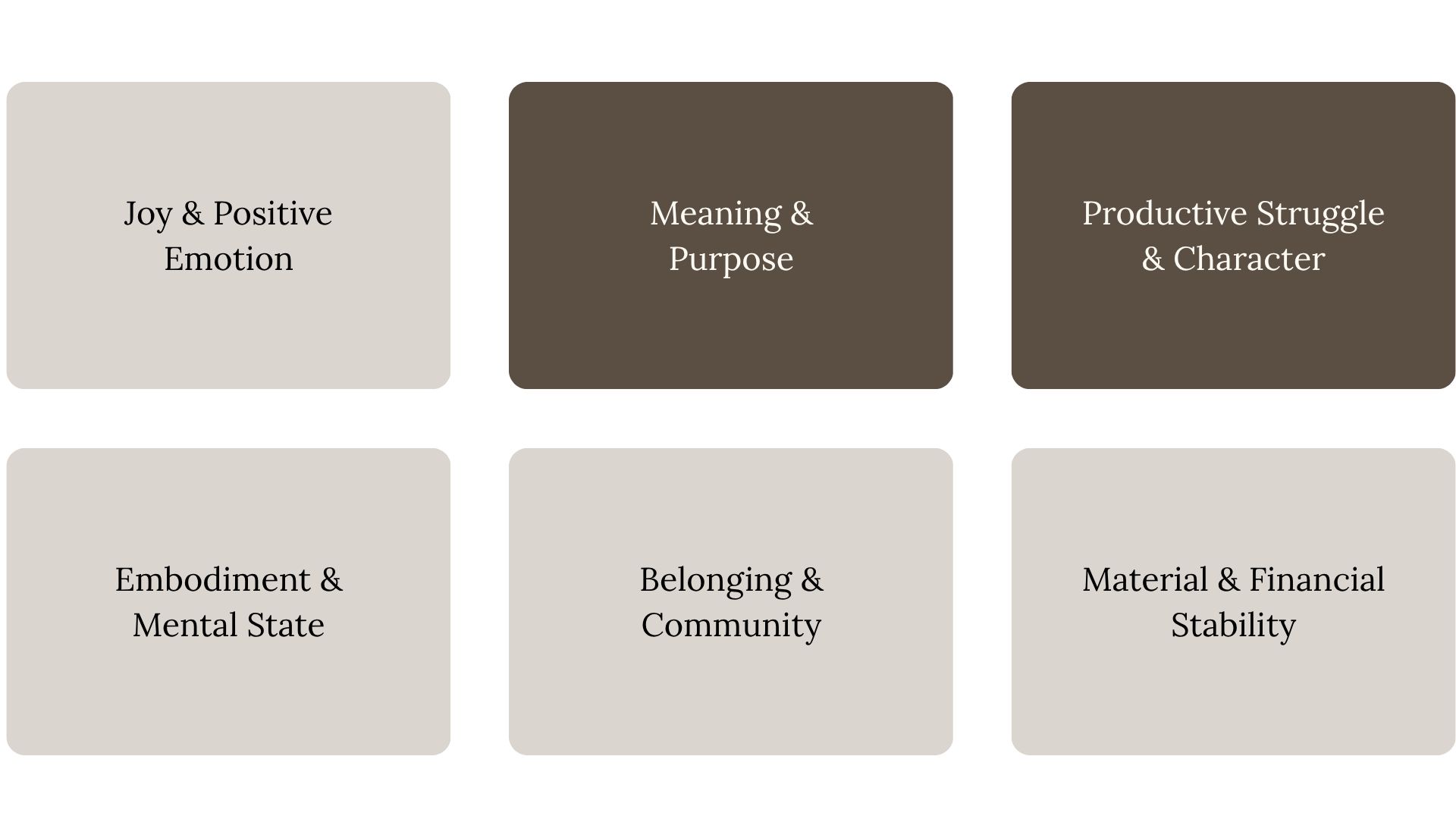
It’s worth noting that these domains aren’t definitive, nor are they strictly correct. They’re part of an emerging reflective practice, and my next big task is to define and refine them based on practitioner feedback and further research.
What I find interesting about these domains is that some of them are things we already talk about a lot in Higher Education, but some aren’t. For example, we often talk about fostering a sense of belonging and community among our students, but we rarely ask how we can bring meaning and purpose into their studies. Because these domains stem from established flourishing and well-being research, I think they deserve deeper exploration in an educational context.
Education Technology
This takes me somewhere else interesting: my own job title. I’ve worked in some form of digital education for the past six or so years. In that time, I’ve had it drilled into me to consistently think about technology-enhanced learning. In other words, where can we use technology to make learning better? But over the past year, I’ve started to notice the opposite: where technology is making the learning worse. I’ve called this “technology-hindered” learning.
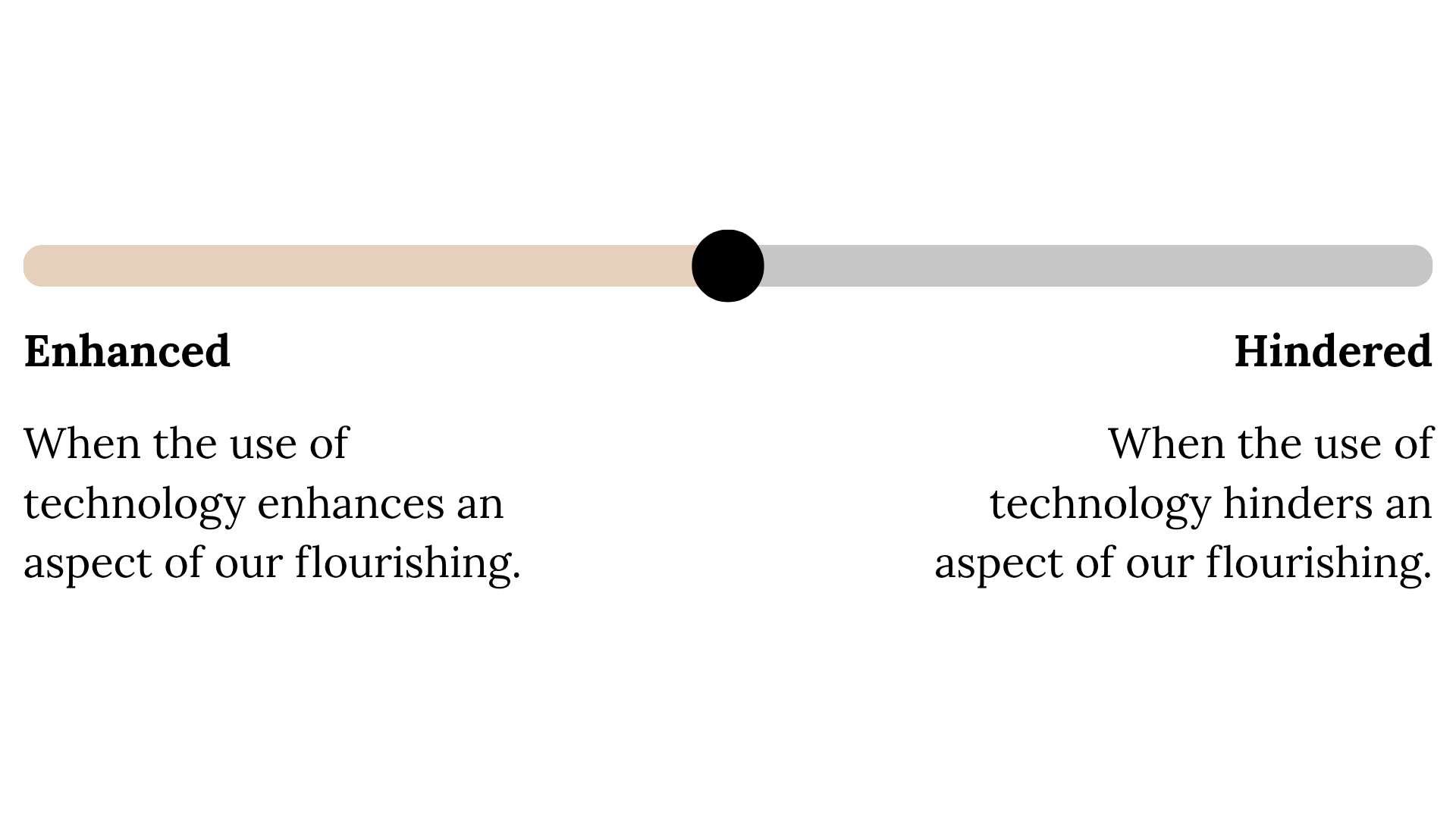
I began to wonder whether we could use the technology-enhanced and technology-hindered divide and map our experiences with technology onto them, while accounting for our individual flourishing. I have a formula for this below:
Technology + Flourishing Domain → Enhanced-to-Hindered Reflection
For example, we might choose AI as our technology to focus on (likely large language models), then choose Meaning & Purpose as our flourishing domain, and ask where AI enhances our sense of meaning and purpose, and where it hinders it.
Personal Reflective Practice
I’ve mostly been experimenting with reflective practice on myself, and it’s been interesting to explore my own experiences. It’s also informed my use of AI, which is the whole point. Let me show you some of my examples below.
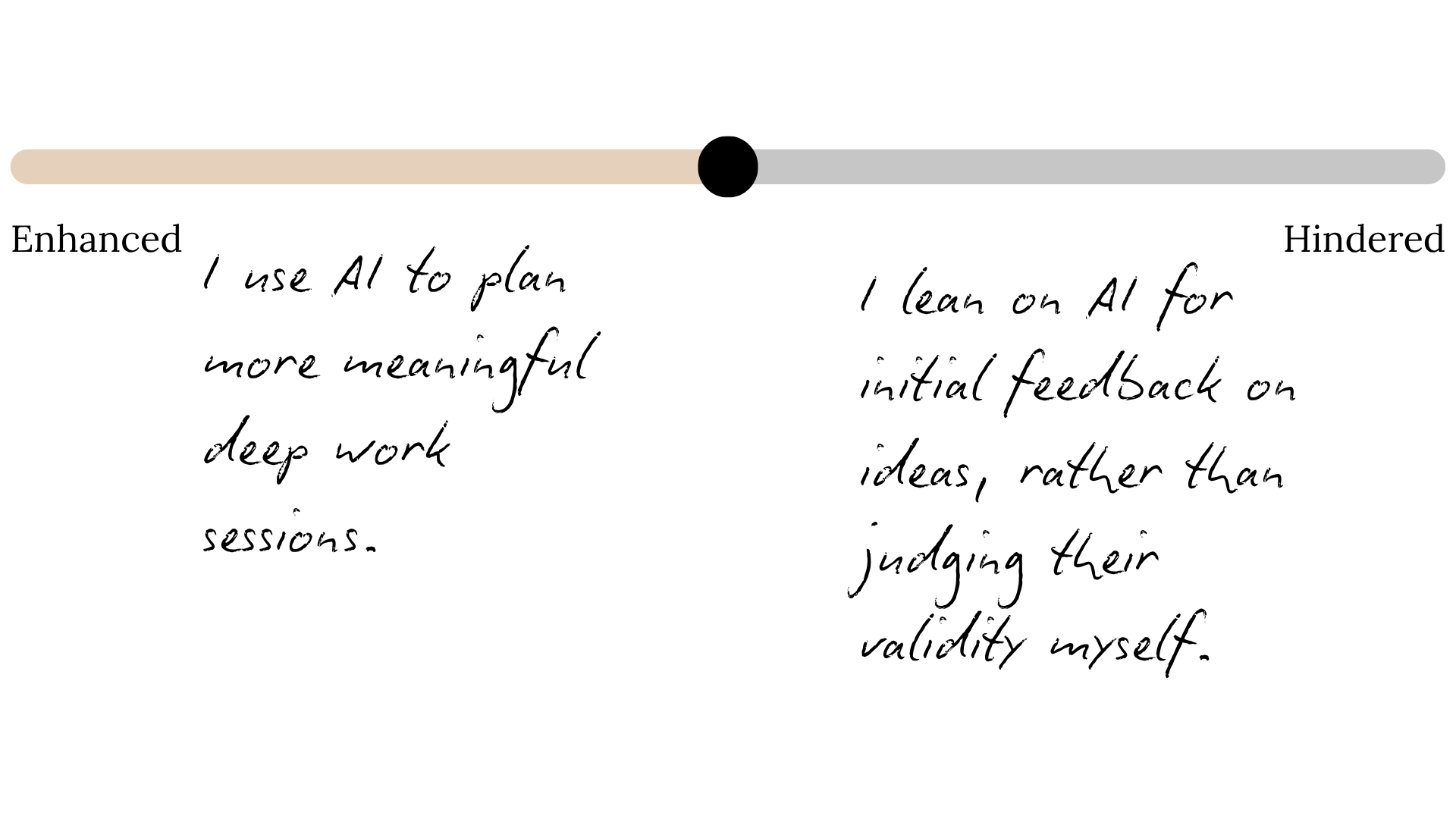
Where does AI enhance your sense of meaning and purpose?
I use AI to plan deep working sessions. These are non-technologically mediated blocks of time where I essentially just read, write, get creative, and solve problems. These sessions give me an incredible sense of meaning because for extended periods, I get to focus on the juicy, fun, and deep stuff I’m interested in. Even though I don’t use AI in these sessions, I have experimented with using AI to plan them. This has given my deep working sessions some structure, which means I’m able to dig deep and get more out of them. In this regard, AI is enhancing my sense of meaning and purpose.
Where does AI hinder your sense of meaning and purpose?
I’ve been asking AI for initial feedback on some of my thoughts and ideas recently. I worry that in doing so, my thoughts will be moulded by the initial feedback I get from AI, and will therefore flatten. I’m no longer exerting judgement over my own ideas, and in that respect AI is hindering my sense of meaning and purpose. It’s taking ownership over something that once felt like my own.
Where does AI enhance productive struggle?
I’ve been asked to do a lot of public speaking lately, and those who know me well know that I really struggle to stand up and speak in front of a crowd (I quite literally lose sleep over upcoming public speaking engagements). Instead of buying some Ben & Jerrys and hoping that if I eat enough of it I might somehow melt into the pot and not have to get on a stage, I downloaded an AI-integrated VR app developed by Cambridge University. Interestingly, this app made my public speaking practice harder, not easier, and definitely not more efficient. Standing up in front of a virtual audience and practicing my talks was far more difficult than practicing in front of a mirror. And yet, it prepared me far more for the talks I was due to give. This is an example of where AI (and VR, in this case) enhanced my opportunities for the kind of struggles that lead to growth.
Where does AI hinder productive struggle?
I initially used AI to help me plan for one of my public speaking engagements. I gave AI some context and asked it to create a script, but when I stood up to practice speaking, it sounded nothing like me. In fact, I felt far away from my own content. So I threw it away, and I started from scratch. What I ended up creating felt more like my own; it was my voice, my story, and I was more confident while presenting it. Interestingly, I also learned more about my own work during the process of creating it. This is an example of where AI has hindered my opportunities for the kinds of struggle that lead to growth, and it's also a good example of intentional non-use of technology.
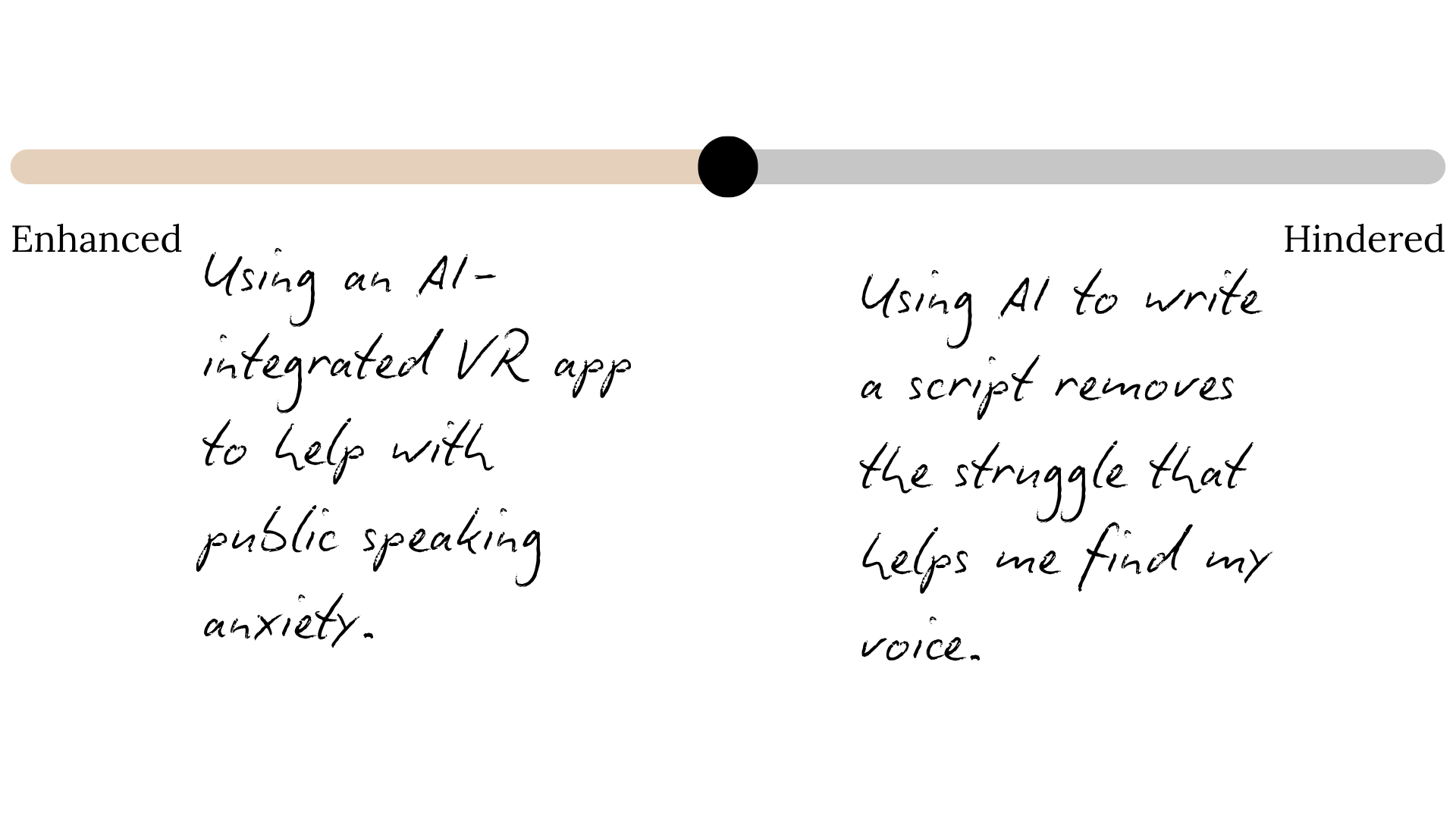
These are just a few examples of my own reflections, and there are many more. I’ve reflected in each area and used that reflection to inform how I use these tools.
Exercising Agency
Let me just circle back to my mum for a moment, who’s hoping that the imminent AI world works better. I know that many of us struggle with these tools. We often feel disempowered by them, and we have no say in how they’re designed and developed, or the incentives that govern the huge organisations creating them. But despite this sense of powerlessness, SlowTeching aims to create a moment to pause, reflect, share those reflections, and begin exercising agency over how we use this technology.
I hope that this reflective practice will ultimately help us on our journey to designing AI into the curriculum, and our lives, not for efficiency, but for flourishing.
Next Steps for SlowTeching
SlowTeching is an emerging reflective framework and practice that aims to give people an opportunity to pause, reflect, and choose how to use existing and emerging technology, rather than defaulting to it.
This post is based on the first talk I’ve given on the concept to a Higher Education audience, and the reception was wonderful. I’m due to deliver two workshops on SlowTeching’s reflective practice in October 2026, including at the Association for Learning Technology conference. This will give me practitioner feedback on both the domains and reflective practice, therefore informing the project’s development.
SlowTeching v0.1 will be published shortly.
If you’re interested in this approach and want to get in touch, then feel free to contact me.
SlowTeching is an independent project developed by Mary-Ellen Simper.
Member discussion