Power & Progress: Technological Development isn’t Inevitable

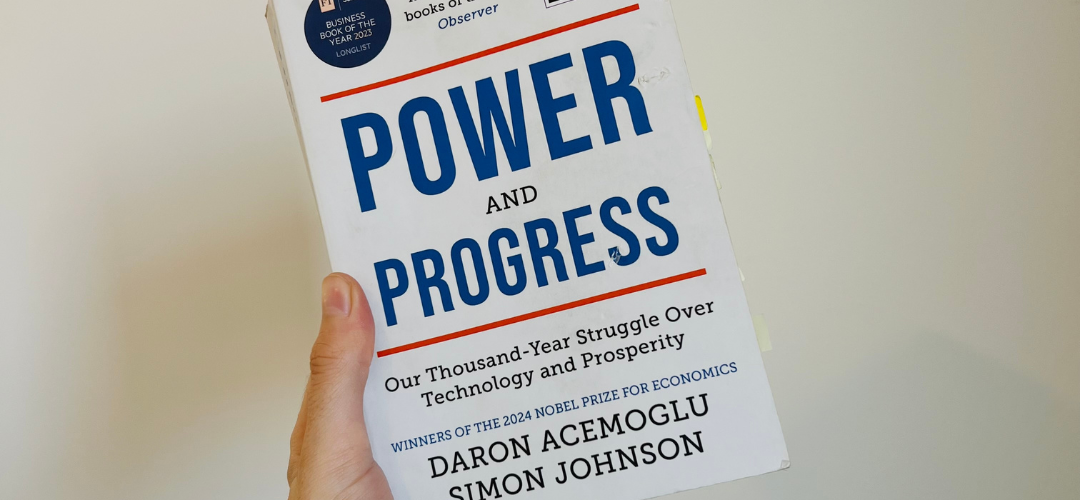
I’ve recently been reading Power and Progress: Our Thousand Year Struggle Over Technology by Daron Acemoglu and Simon Johnson. I’m only about 100 pages into this 400+ page read and I’m already fascinated!
I’m sharing a couple of the moments that have most impacted my thinking…
Behaviour as Progress
One of the most interesting moments in the book so far is when the idea of behaviour as progress comes into play. Most tech leaders like Elon Musk or Bill Gates agree that technological progress must be relied on to solve human problems, but Demis Hassabis is quoted as saying something slightly different…
“Either we need an exponential improvement in human behaviour - less selfishness, less short-termism, more collaboration, more generosity - or we need an exponential improvement in technology.” - Demis Hassabis, pp.32-33
Hassabis delineates between human behaviour and technological development as two separate ways that humanity can progress. Of course, we seem to have chosen technology as our primary vehicle, but what would it look like to choose human behaviour?
Over the last year, I’ve been exploring and writing about human flourishing, and I’ve come to think about this strand of human experience as an avenue for human progress in its own right (whether without technology or, more likely, alongside it).
Flourishing is about developing joy, meaning and purpose, character and virtue, physical and mental wellbeing, social connections and material stability. It’s about being a good human and leading a good life, and it’s linked to some of the behaviours that Hassabis describes - “less selfishness, less short-termism, more collaboration, more generosity”.
My current vehicle for this behaviour-based form of progress is education, which arguably has much less power than big tech. Of course, flourishing is just one possible alternative to techno-optimism, and it will be flawed in its own unique ways. But if there’s a small chance that humanity has taken a wrong turn, that we’re valuing the wrong things, that we’ve created a system that caters to only a few… then I say that we should at least explore something else. Perhaps flourishing is a good place to start.
Choose, don’t Default: Technology isn’t Inevitable
In the book so far, the authors argue against technological progress as inevitable, and instead as a collective choice.
I grew up during the advent of iPods, iPhones and the personal computer. Technology was always praised as a gift, as progress. In fact, I can hardly conceive of a world without modern digital technologies.
This led me to an interesting question: what exactly is the alternative to technology?
Is it possible that I find it hard to conceive of progress that is not technological because I have been indoctrinated into a society that blindly believes all technology equals progress? Possibly.
It’s made me think more deeply about other avenues for progress, too, particularly those that come under the flourishing umbrella. What about morality or collective human good? What would happen if, instead of the new iPhone or AI model, we glorified kindness as our collective vehicle for progress? As always, I have more questions than answers, but it’s an interesting thought trail to follow, and perhaps one we don’t think about enough.
The AI narrative also tells us that we’ll become more productive than ever before as a result of AI. So productive, in fact, that we won’t even need to work anymore. But is this a good thing, and who decided that “productivity” was the core attribute for progress? Why not strive to be more deliberate, precise, creative, or thoughtful?
“New techniques and machines are not gifts descending unimpeded from the skies. […] they can generate shared prosperity or relentless inequality, depending on how they are used and where new innovative effort is directed.” p.22
In other words, the answer is in human choice. Whether we blindly follow techno-optimism or invest in the flourishing of ourselves and our fellow human beings, is up to us. We can choose what we do with technology, but that choice should be collective, not reserved for the special few.
Conclusion
This book, so far, is providing both courage and hope. The delineation between technology and human behaviour, in particular, has enabled me to position some of the work I’ve been doing on human flourishing into the broader technological narrative. I’m realising that alternatives exist, but they seem to be hiding behind dominant narratives, and we’re not empowered enough to propose change.
The reality is that we have multiple paths ahead of us, and it can be tempting to think of them as binaries. Will we progress in terms of technological advancement, or in terms of human flourishing? Will we focus on productivity, or will we focus on joy, meaning, and connection? Do we want a life of convenience, or a life of good, purposeful work?
But the binary could be a problem itself. Is it not also possible for us to develop technologically while developing behaviourally? Could we not learn to flourish with and alongside technology, rather than in spite of it?
These are not questions that should be answered by a few humans alone. They are our collective questions, and ones we should decide on, together.
Member discussion